
 E-mail:lizhi@pxball.cn
How to Determine When Inert Ceramic Balls Need to Be Replaced?
(Practical On-Site Evaluation Guide)
The replacement timing of inert ceramic balls should be evaluated from three core dimensions:
equipment operating parameters, on-site condition of the ceramic balls, and process performance.
If any one key symptom appears, it indicates that the ceramic balls have failed and should be replaced.
If multiple symptoms occur simultaneously, immediate shutdown and replacement are strongly recommended to avoid equipment damage and production accidents.
1. On-Site Inspection of the Ceramic Balls
(Most direct and reliable judgment method)
During shutdown, open the manhole of the reactor or column and randomly inspect ceramic balls in different zones. Replacement is required if any of the following conditions are observed:
● Physical Damage
-
Widespread cracking, chipping, pulverization, or surface friability
-
Large amounts of broken ceramic balls or accumulated ceramic powder
● Structural Failure
-
Collapse of the ceramic ball layer, bridging, or channeling
-
Uneven support layer unable to evenly support catalysts or process materials
● Severe Contamination or Corrosion
-
Heavy coking or scaling that cannot be cleaned
-
Chemical corrosion, dissolution, or deformation caused by process media, resulting in loss of original density and strength
2. Equipment Operating Parameters
(Early warning signs without shutdown)
Routine monitoring of operating data can help predict ceramic ball failure in advance.
If the following abnormalities occur—and other causes (such as catalyst deactivation or pipeline blockage) have been excluded—ceramic ball replacement should be scheduled:
● Sudden Increase in Pressure Drop
-
Inlet–outlet pressure differential increases by ≥ 20% compared to normal operation
-
Typically caused by ceramic ball pulverization or fragments blocking the bed or distributors
● Abnormal Temperature Distribution
-
Local temperature deviation of ≥ 50°C inside the equipment
-
Caused by channeling or collapse of the ceramic ball layer, leading to uneven gas or liquid distribution and localized overheating or incomplete reaction
● Unstable Flow Rate
-
Irregular fluctuations in inlet or outlet flow without valve or control system faults
-
Often due to ceramic debris blocking pipelines, flow meters, or distributors
-
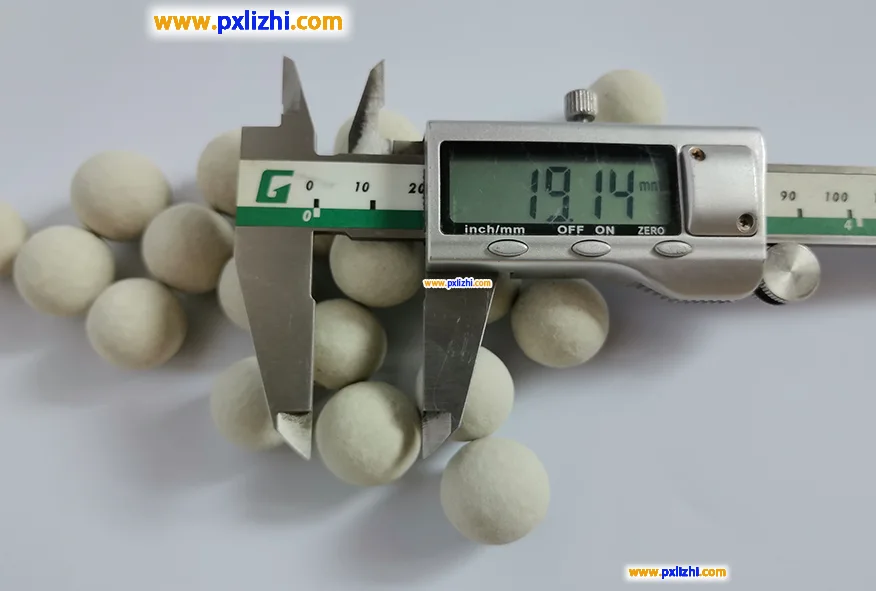
inert alumina ceramic ball factory
3. Process Performance Indicators
(Indirect but critical signals reflected in production results)
If the following issues occur on the production side, and catalysts and process parameters are confirmed to be normal, they are usually chain reactions caused by ceramic ball failure and require immediate replacement:
● Declining Product Quality
-
Reduced product purity or yield
-
Increased impurity levels due to ceramic dust contamination or uneven flow causing incomplete reaction or separation
● Accelerated Catalyst Consumption
-
Significantly increased catalyst replacement or replenishment frequency
-
Resulting from loss of ceramic ball support and buffering, leading to catalyst abrasion, compression, and rapid activity loss
● Increased Downstream Equipment Failures
-
Frequent blockage or wear in pumps, heat exchangers, and filters
-
Discovery of ceramic powder or broken balls during maintenance confirms severe ceramic ball degradation
4. Recommended Replacement Intervals
(Preventive replacement to avoid unexpected failures)
Even if no obvious failure signs are present, preventive replacement schedules should be established based on operating severity to reduce unplanned shutdown risks:
-
Severe conditions (high temperature ≥ 800°C, high pressure, strong corrosion, high flow rate):
Replace every 1–2 years -
General conditions (medium temperature ≤ 600°C, normal pressure, non-corrosive):
Replace every 3–5 years -
Mild conditions (ambient temperature, low pressure):
Replace every 5–8 years
Note:
During every scheduled maintenance shutdown, the ceramic ball condition must be inspected.
-
Localized damage → partial replacement is acceptable
-
Damage exceeding 30% of the layer → full-layer replacement is recommended
Quick Judgment Checklist
-
Pulverization or breakage → Replace immediately
-
Sudden pressure drop increase → Replace
-
Channeling, coking, or severe fouling → Replace
-
Product quality deterioration → Replace
-
No obvious abnormalities → follow condition-based replacement cycle
Always inspect during maintenance:
Partial damage → replenish locally;
Widespread damage → replace the entire layer.

Reviews
There are no reviews yet.