
 E-mail:lizhi@pxball.cn
Why Is Alumina (Al₂O₃) Content So Important for Inert Ceramic Balls?
Alumina (Al₂O₃) is the core and dominant component of inert ceramic balls. Its content directly determines three critical performance indicators:
-
Mechanical strength
-
Chemical stability (inertness)
-
High-temperature resistance
These properties are exactly what determine whether inert ceramic balls can adapt to industrial operating conditions and maintain long-term, stable performance. They are also the fundamental reason behind the performance differences, application ranges, and pricing distinctions among low-alumina, medium-alumina, and high-alumina ceramic balls.
In simple terms:
The higher the Al₂O₃ content, the better the overall performance, and the more demanding the operating conditions it can withstand.
That said, there is no absolute “best” — only the most suitable alumina content for a given application.
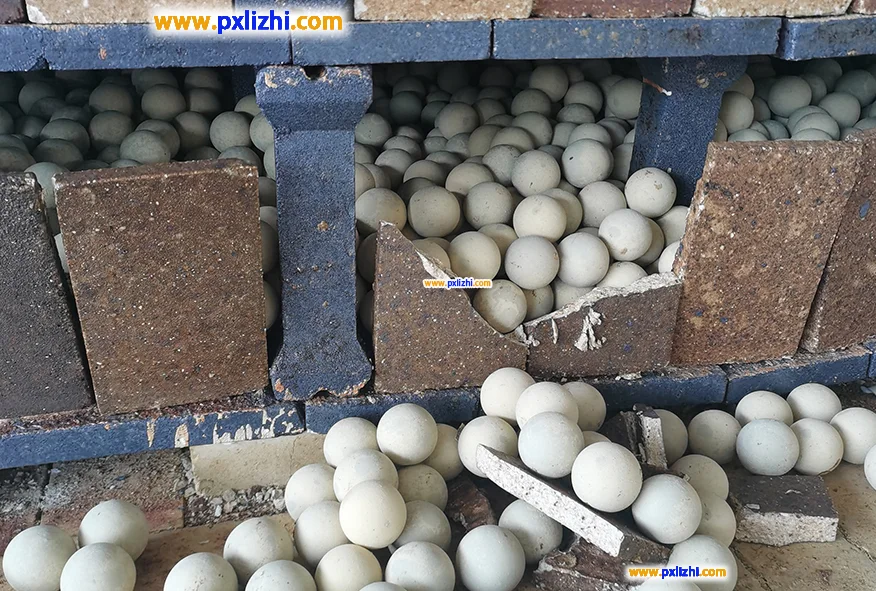
1. Alumina Content Directly Determines Mechanical Strength
The Core Guarantee of Compressive and Wear Resistance
Al₂O₃ is a ceramic phase with high hardness and high density. As alumina content increases, ceramic balls achieve:
-
Higher sintering density
-
Fewer internal pores
-
Greater compressive strength, wear resistance, and impact resistance
Typical performance differences by alumina content include:
-
Low-alumina ceramic balls (Al₂O₃ ≤ 60%)
Lower strength and higher wear rate; suitable only for ambient temperature, low-pressure, and low-flow applications. -
High-alumina ceramic balls (92% / 95% Al₂O₃)
Compressive strength exceeding 3000 N per ball, abrasion loss ≤ 0.05%, capable of withstanding high pressure, high flow velocity, and severe material scouring. These are the mainstream choice in chemical and petrochemical industries.
If alumina content is insufficient, ceramic balls are prone to breakage and pulverization, leading to pipeline blockage, catalyst abrasion, and the same consequences associated with inadequate strength.
2. Alumina Content Determines High-Temperature Resistance and Thermal Stability
A Core Requirement for High-Temperature Processes
Al₂O₃ has a melting point of 2072°C, along with a low thermal expansion coefficient and excellent thermal shock resistance. Higher alumina content directly translates into:
-
Higher maximum operating temperature
-
Better resistance to rapid temperature changes
Typical comparisons include:
-
Low-alumina ceramic balls
Maximum temperature resistance generally ≤ 600°C, prone to cracking under sudden temperature fluctuations. -
95% high-alumina ceramic balls
Operating temperature range of approximately 1200–1600°C, suitable for reactors, distillation columns, and other high-temperature equipment, and able to withstand frequent heating and cooling cycles without damage.
This directly fulfills the high-temperature resistance requirement of inert ceramic balls and ensures reliable performance in thermal-intensive processes.
3. Alumina Content Determines Chemical Inertness
Preventing Side Reactions with Process Media
Pure Al₂O₃ is a chemically neutral and highly stable oxide, resistant to reactions in acidic, alkaline, oxidizing, or reducing environments.
In contrast, other components commonly found in ceramic balls—such as SiO₂, CaO, and MgO—are relatively more chemically active.
As alumina content increases, the proportion of these impurities decreases, resulting in stronger chemical inertness:
-
High-alumina ceramic balls
Rarely react with acids, alkalis, high-temperature reaction gases, or molten materials. They do not contaminate products, consume reactants, or suffer structural damage due to chemical reactions. -
Low-alumina ceramic balls
Higher impurity content makes them more susceptible to chemical corrosion in strong acid/alkali or high-temperature environments, leading to surface powdering, structural loosening, and eventual loss of support function.
4. Alumina Content Determines Service Life and Total Operating Cost
Ceramic balls with higher Al₂O₃ content offer:
-
Higher density
-
Greater mechanical strength
-
Superior corrosion resistance
As a result, they are far less likely to break or degrade during operation and typically have a much longer service life than low-alumina ceramic balls.
Low-alumina products, by contrast, fail more quickly and require frequent replacement. This not only increases material procurement costs but also leads to unplanned shutdowns, maintenance expenses, and production losses, significantly raising total operating costs.
Conclusion
Alumina (Al₂O₃) content is the core performance benchmark of inert ceramic balls. It determines:
-
Whether the ceramic balls can adapt to specific industrial operating conditions
-
Their long-term stability and reliability
-
Their service life and overall economic efficiency
Higher alumina content is not inherently “better” for every application.
The optimal choice is the alumina content that best matches the actual operating conditions.

Reviews
There are no reviews yet.