
 E-mail:lizhi@pxball.cn
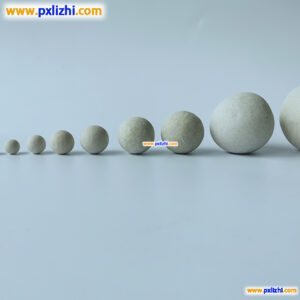
What Are the Main Chemical Components of Inert Ceramic Balls?
The core chemical component is Alumina (Al₂O₃), whose content varies significantly by material grade (ranging from 30% to 99%+).
Key auxiliary components include Silicon Dioxide (SiO₂) and kaolin (a composite primarily consisting of alumina and silica). Trace impurities such as Iron Oxide (Fe₂O₃) and Calcium Oxide (CaO) may also be present in some grades, but their concentrations are extremely low and do not impact core performance.
Inert Ceramic Ball Chemical Composition FAQ
Q1: How Do the Main Chemical Components Affect Performance?
A1:
- Alumina (Al₂O₃): Higher content directly improves mechanical strength, thermal stability, and corrosion resistance.
- Silicon Dioxide (SiO₂): Reduces production costs; however, excessive amounts can compromise structural strength.
- Trace Impurities: Negligible impact on core mechanical and chemical properties when present in small quantities.
Q2: What Are the Typical Ratios of Main Chemical Components?
A2:
- Alumina (Al₂O₃): 30% – 99%+ (varies by material grade).
- Silicon Dioxide (SiO₂): 5% – 60%.
- Impurities (Fe₂O₃, CaO, etc.): ≤ 1%.
Q3: What Are the Testing Methods for Main Chemical Components?
A3:
- Alumina: Titration method, Spectrophotometry.
- Silicon Dioxide: Gravimetric method, Colorimetric method.
- Trace Impurities: Atomic Absorption Spectroscopy (AAS).

Reviews
There are no reviews yet.